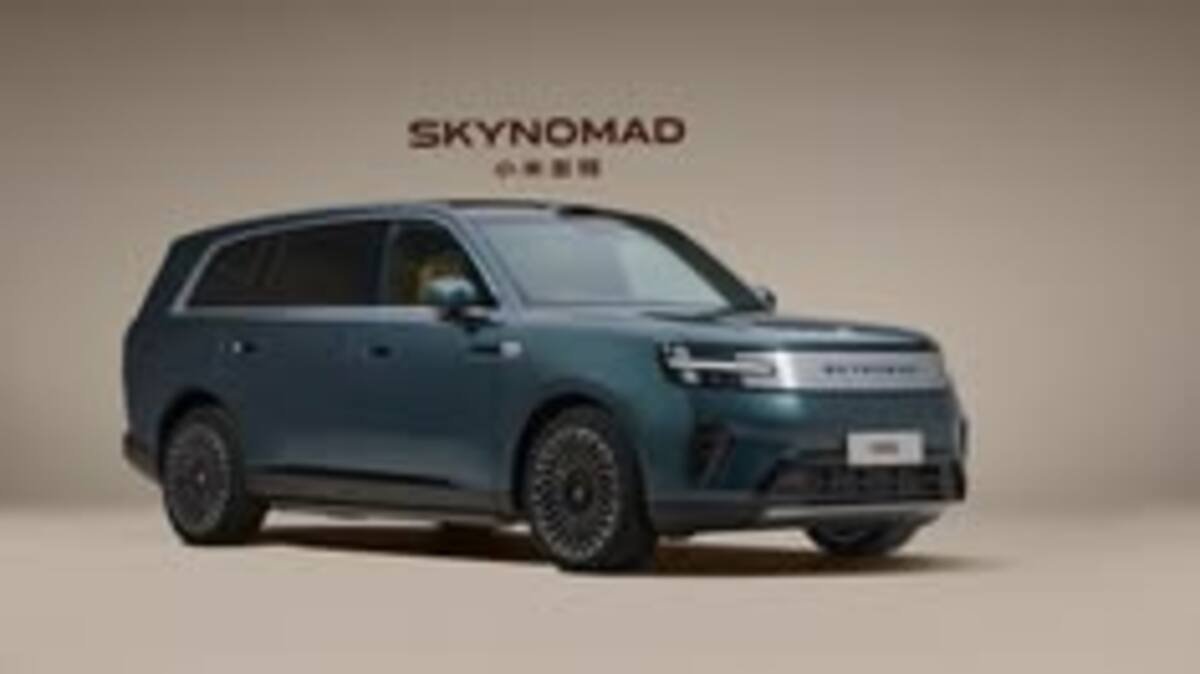
Xiaomi has finally made the leap completely clear of their high-end electric sedans and sporty electric crossovers. On July 30, the company announced the SkyNomad lineupa set of two large family-friendly SUVs built with range-extender units instead of pure battery power. This is Xiaomi’s inaugural series of production vehicles built with an on-board petroleum engine to keep the electric motors alive while the battery gets a recharge. The flagship skyNomad N90 Max is a full-sized 7 seater SUV over 5.
2 meters long.3 Xiaomi sells it as a “moving living room ” features like a completely flat floor extending from the driver to the back door, sliding rails that facilitate variable seating configurations, and a cabin designed to be expandable for passengers or luggage. A smaller, 5 seat version, the skyNomad N70 Max, is also part of the first stage. Both vehicles are built on the company’s new Kunlun architecture targeted at larger vehicles.
Capacity and use flexibility are prioritized. It comprises hybrid electric drive, with a dual-motor powertrain and an otherwise-never idle 1.5 liter turbo four. It is an electric-gas hybrid, with the four doing nothing but providing overall charge to the batteries or power directly to the motors. The N90 Max is equipped with a 76 kWh battery and 60-liter fuel tank, with Chinese cycle range ratings of 464 km when relying entirely on the electric powertrain, and up to 1,705 km if effort is reserved for the ratios combining for the upper-bound range. The N70 Max can achieve up to 505 km of pure-electric range based on the battery configuration. Zero-to-100 km/h in the dual-motor variants of the N70 Max and N90 Max takes 5.
9 seconds, with a limited top-speed of 190 km/h. Pre-sales commenced right after the launch event. The pre-sale price for the N90 Max is 299,900 Yuan and for the N70 Max it is 259,900 Yuan. The Official market launch and first shipment for the devices is set for September.
Xiaomi has already teased that further Pro and Standard variants are soon to come. This shows a thorough understanding of the preferences of Chinese consumers to go into the range-extender class. Consumers wish for the silent instant torque of electric power for their daily drive, while equally require the range and convenience of not having to hunt for charging stations on the longer journeys. Companies like Li Auto have built successful business models around precisely this blend of electric and petrol.
Xiaomi entry adds another high-profile rival in a crowded yet still-sparse segment. For inside, the focus is still comfort and adaptability. Zero-gravity seats, power-rotating front chairs, a sizable fridge, and an upscale audio system are featured on higher-spec models. The flat-floor architecture does away with the hump that regularly constrains the legroom and cargo capacity of a 3-row SUV.
product also promotes an extensive safety architecture and sophisticated driver-assist tech that encompasses LiDAR. When it comes to Xiaomi, SkyNomad is not only a new body style. It is really a new target group after entering the SUV market with the SU7 sedan and YU7 crossover, as the new target customer has a different judgment of the value of a vehicle.